
So, you’re an adult considering straightening your teeth. Congratulations on taking a step towards a healthier, more confident smile! The good news is that advancements in orthodontics offer more options than ever before. The two main contenders? Traditional braces and the revolutionary Invisalign.
But with all the information out there, you might be asking: “Which is better for adults?” “Is Invisalign faster than braces?” “What about the cost of Invisalign vs braces?”
You’re not alone. Many adults grapple with these questions. This comprehensive guide will break down everything you need to know about Invisalign vs. braces, helping you make an informed decision for your unique smile journey.
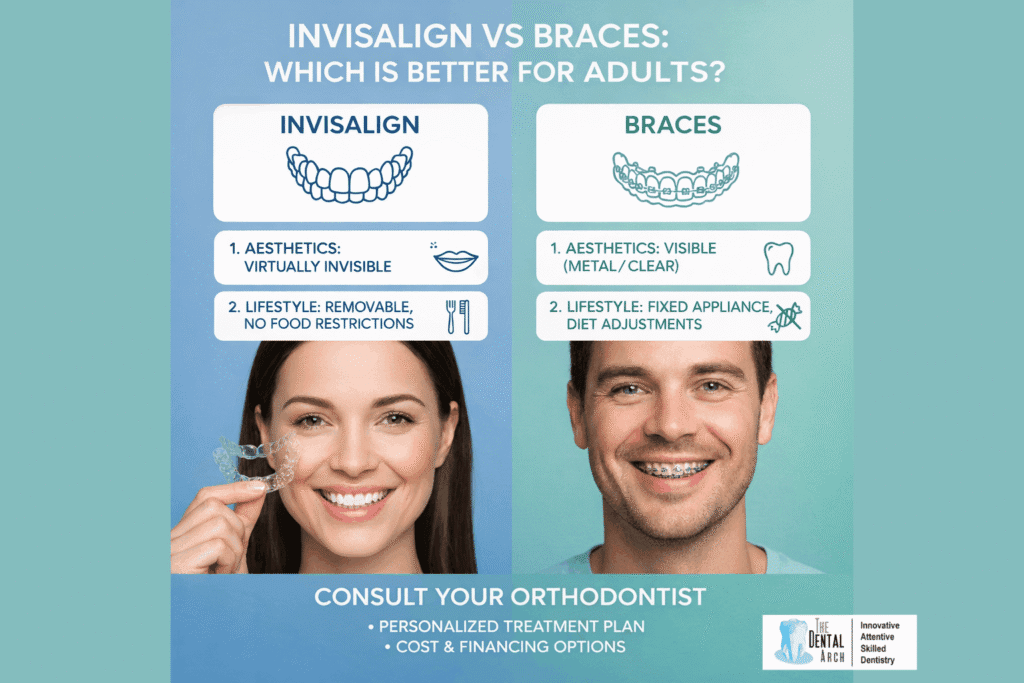
Before we dive into the nitty-gritty, let’s quickly define our terms:
Traditional Braces: These are what most people picture when they think of orthodontics. They consist of metal brackets bonded to the front of your teeth, connected by a wire. This wire is periodically adjusted by your orthodontist to gradually shift your teeth into alignment. While metal braces are still common, clear or ceramic braces are also available for a more subtle look.
Invisalign (Clear Aligners): This innovative system uses a series of custom-made, virtually clear plastic aligners that fit snugly over your teeth. You wear each set of aligners for about one to two weeks, removing them only to eat, drink, brush, and floss. Each new set of aligners gently moves your teeth closer to their desired position.
Now, let’s compare them head-to-head.
This is often the biggest deciding factor for adults.
Invisalign: As the name suggests, Invisalign aligners are nearly invisible. This means you can straighten your teeth discreetly, without the noticeable appearance of metal brackets and wires. For many adults, especially those in professional settings, this aesthetic advantage is a game-changer.
Braces: While clear or ceramic braces offer a less conspicuous option than traditional metal braces, they are still visible. Lingual braces, which are placed on the inside of the teeth, are another “invisible” option but come with their own set of considerations.
Invisalign: The smooth plastic aligners are generally more comfortable than braces, which can sometimes cause irritation from brackets and wires rubbing against the cheeks and gums. A huge plus for Invisalign is that you can remove the aligners for eating, drinking, brushing, and flossing. This means no food restrictions and easier oral hygiene.
Braces: Braces are fixed appliances, meaning you cannot remove them. This requires adjustments to your diet (avoiding sticky, hard, or crunchy foods) and a more diligent oral hygiene routine to clean around the brackets and wires. Initial discomfort after adjustments is also common.
The question of “Invisalign vs braces, which is faster?” or “How long does Invisalign take vs. braces?” is frequently asked, and the answer isn’t always straightforward.
Invisalign: For many mild to moderate cases, Invisalign can be comparable to or even slightly faster than braces, typically ranging from 6 to 18 months. However, it heavily relies on patient compliance – you must wear your aligners for 20-22 hours a day for them to be effective.
Braces: Traditional braces generally take anywhere from 18 to 36 months, depending on the complexity of the case. While individual treatment times vary, braces are often more efficient for complex bite issues and significant tooth movements, as they provide continuous force.
Key Takeaway: For simpler cases and compliant patients, Invisalign can be quite efficient. For very complex cases, braces may still offer a more predictable and sometimes faster solution overall.
“Invisalign vs braces cost” is a significant consideration for most adults. The price can vary widely based on the complexity of your case, the length of treatment, your location, and your orthodontist’s fees.
Invisalign Cost: In general, Invisalign tends to be slightly more expensive than traditional metal braces. The average cost can range from $3,000 to $8,000 USD (or INR 1,50,000 to INR 3,50,000+ in India, for example). This higher cost often reflects the advanced technology and customization involved.
Braces Cost: Traditional metal braces typically range from $3,000 to $7,000 USD (or INR 70,000 to INR 2,50,000+ in India). Clear or ceramic braces might be slightly more than metal, while lingual braces are usually the most expensive type of fixed appliance.
Financing and Insurance: It’s crucial to consult with your orthodontist’s office regarding payment plans. Many offer flexible financing options. Additionally, check with your dental insurance provider, as some plans cover a portion of orthodontic treatment, regardless of whether you choose Invisalign or braces.
Invisalign: Highly effective for a wide range of orthodontic issues, including overcrowding, gaps, and certain bite problems (overbite, underbite, crossbite). However, for very complex cases, severe rotations, or significant vertical movements, traditional braces might still be the preferred method.
Braces: Extremely versatile and effective for almost all types of orthodontic problems, from mild to severe. They are particularly robust for complex bite corrections and precise tooth movements.
Ultimately, there’s no single “better” option. The best choice depends on your individual needs, lifestyle, budget, and the specific orthodontic issues you need to address.
Consider Invisalign if:
Aesthetics are your top priority, and you want a virtually invisible treatment.
You value the flexibility of removing your aligners for eating and cleaning.
You are highly disciplined and committed to wearing your aligners for 20-22 hours a day.
Your orthodontic issues are mild to moderate.
You have complex orthodontic issues that require more significant movement.
You prefer a fixed appliance that you don’t have to remember to wear.
Cost is a primary concern, and you’re looking for a potentially more budget-friendly option.
You don’t mind the appearance of metal (or clear) brackets.
The most critical step in deciding between Invisalign and braces is to consult with a qualified orthodontist. They will perform a thorough examination, including X-rays and digital scans, to assess your specific condition. Based on their expert diagnosis, they can recommend the most effective treatment plan for you and discuss whether Invisalign, braces, or even a combination of treatments is the best path to your ideal smile.
Regardless of whether you choose Invisalign or braces, remember that orthodontic treatment doesn’t end when your appliances come off. Retention is crucial to maintain your newly straightened smile. This usually involves wearing a retainer (either removable or fixed) as prescribed by your orthodontist. Neglecting retainer wear can lead to your teeth shifting back, undoing all your hard work!
Both Invisalign and braces are highly effective treatments for straightening teeth in adults, each with its own set of advantages. By understanding the differences in aesthetics, comfort, treatment time, and cost, you can have a more informed discussion with your orthodontist and embark on the journey to the beautiful, confident smile you’ve always wanted.
Your perfect smile awaits!
Generally, for complex dental issues, braces are faster because they provide more force and constant movement. However, for mild to moderate gaps or overcrowding, Invisalign can be just as fast, or sometimes faster (often taking 6 to 18 months), provided you wear the aligners for the required 22 hours a day.
Yes, typically. Invisalign costs can range between $3,000 to $8,000, whereas traditional metal braces usually range between $3,000 to $7,000. In India, Invisalign costs are often higher due to the custom technology and lab fees involved in creating the clear aligners.
One of the biggest perks of Invisalign is that there are no food restrictions. Since you remove the aligners to eat, you can enjoy hard, sticky, or crunchy foods that are strictly off-limits with traditional braces. Just remember to brush your teeth before putting the aligners back in!
Yes. For severe structural issues, rotated teeth, or major bite corrections (like a deep overbite), traditional braces are often the better choice. Braces give orthodontists more precise control to move each tooth individually into its correct position.
To see results, you must wear your Invisalign aligners for at least 20 to 22 hours per day. If you frequently forget to put them back in after meals, your treatment time will take much longer, and braces might have been a better "set it and forget it" option for you.