Replacing all missing teeth is one of the biggest decisions a patient can make for their oral health, confidence, and quality of life. For many people, removable dentures feel uncomfortable, unstable, or unnatural. This is why more patients today are choosing full mouth dental implants — a long-term solution that looks and functions much closer to natural teeth.
One of the most common questions patients ask is:
What is the cost of full mouth dental implants in India?
In India, the cost of full mouth dental implants generally ranges from ₹3,50,000 to ₹18,00,000 or more, depending on the treatment type, implant brand, number of implants, prosthetic material, and the expertise of the dental team.
Options like All-on-4 dental implants, All-on-6 implants, and zirconia full arch bridges have made complete teeth replacement more predictable and accessible than ever before.
In cities like Mumbai, advanced implant dentistry clinics now use technologies such as CBCT scans, digital smile designing, guided implant surgery, and premium imported implants to improve precision, comfort, and long-term outcomes.
This guide explains everything patients need to know about:
Full mouth dental implants are a permanent teeth replacement solution used when a person has lost most or all of their teeth in the upper jaw, lower jaw, or both.
Instead of replacing each tooth individually, dentists strategically place multiple implants into the jawbone to support a fixed bridge or prosthesis.
These implants act like artificial tooth roots and help support:
Typically:
The implants fuse with the jawbone through a process called osseointegration, creating a strong foundation for fixed teeth.
Feature | Full Mouth Implants | Traditional Dentures |
Fixed in mouth | Yes | No |
Stability | Excellent | May slip |
Chewing ability | Strong | Reduced |
Bone preservation | Yes | No |
Natural appearance | High | Moderate |
Comfort | Better | Can irritate gums |
Lifespan | Long-term | Needs frequent replacement |
Many patients choose implants because they allow them to:
The cost of full mouth dental implants in India depends on multiple clinical and technical factors. The biggest difference in pricing usually comes from:
Treatment Type | Estimated Cost in India |
Implant-supported overdenture (single arch) | ₹1,50,000 – ₹3,50,000 |
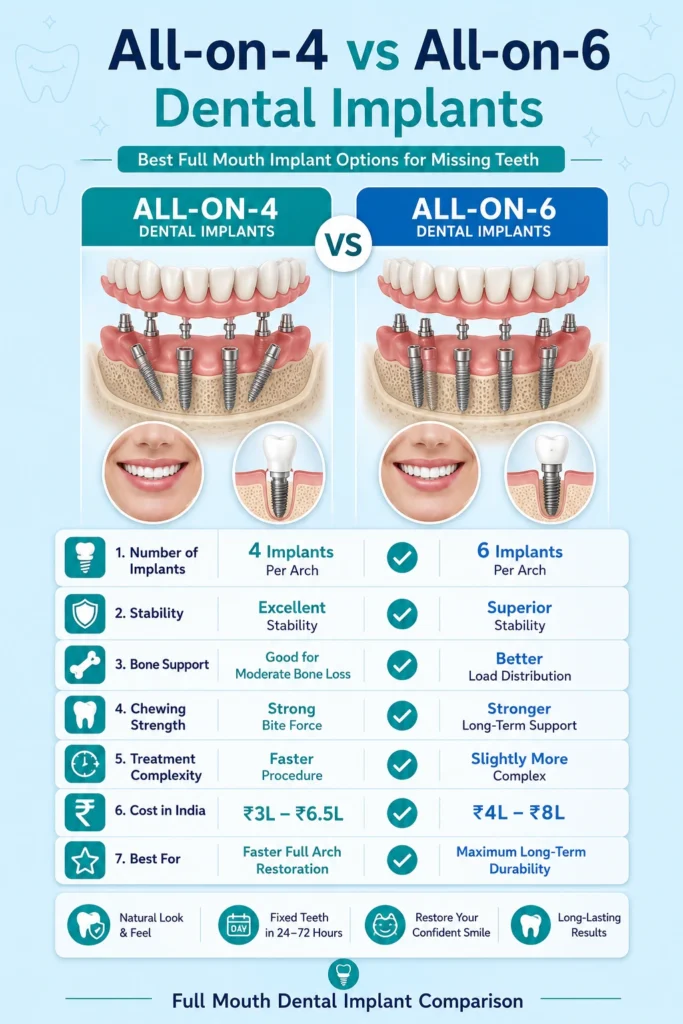
All-on-4 dental implants cost in India (single arch) | ₹3,00,000 – ₹6,50,000 |
All-on-6 dental implants price (single arch) | ₹4,00,000 – ₹8,00,000 |
Full mouth implants (both arches) | ₹7,00,000 – ₹16,00,000 |
Zirconia fixed bridge full mouth | ₹10,00,000 – ₹18,00,000+ |
Acrylic hybrid prosthesis | ₹4,00,000 – ₹8,00,000 |
Disclaimer: The prices mentioned in this article are approximate and may vary depending on the patient’s dental condition, implant system used, additional procedures, and clinic location. This article is intended for informational purposes only and should not replace professional dental consultation.
Mumbai is one of India’s leading cities for advanced implant dentistry. However, the cost of treatment may vary significantly from one clinic to another.
Why Implant Costs Differ in Mumbai
1. Surgeon Experience
An experienced implantologist or prosthodontist may charge more due to:
Advanced training
Complex case handling
Better precision
Long-term treatment planning
2. Technology Used
Modern implant clinics may use:
CBCT scans
3D-guided implant surgery
Digital impressions
Intraoral scanners
Smile designing software
These improve accuracy and patient comfort but can affect pricing.
3. Implant Brand
Imported implant systems from internationally recognized manufacturers generally cost more than local systems.
4. Prosthetic Material
The final bridge material significantly affects cost.
Material | Durability | Cost |
Acrylic hybrid bridge | Moderate | Lower |
PFM bridge | Good | Moderate |
Zirconia bridge | Excellent | Premium |
Patients searching for full mouth implants in Mumbai often prioritize long-term reliability, aesthetics, and chewing function over low-cost temporary solutions.
All-on-4 Dental Implants
All-on-4 uses four strategically placed implants to support a full arch of teeth.
Suitable For
Patients with moderate bone loss
Those seeking a quicker full arch solution
Patients wanting fixed teeth without multiple implants
Advantages
Fewer implants required
Lower surgical complexity
Faster treatment
Often allows same-day temporary teeth
Disadvantages
May not suit severe bone loss cases
Load distribution differs from All-on-6
Durability
Long-lasting with proper maintenance.
Estimated Cost
₹3,00,000 – ₹6,50,000 per arch
All-on-6 Dental Implants
All-on-6 uses six implants for additional support and stability.
Suitable For
Patients with stronger jawbone support
Those wanting greater long-term load distribution
Advantages
Better chewing efficiency
Increased support
Improved long-term stability
Disadvantages
Slightly higher cost
Longer surgery in some cases
Estimated Cost
₹4,00,000 – ₹8,00,000 per arch
Implant-Supported Dentures
These dentures are supported by implants but may still be removable.
Suitable For
Patients seeking improved denture stability
Elderly patients
Budget-conscious cases
Advantages
More stable than traditional dentures
Lower cost than fixed bridges
Disadvantages
May still require removal for cleaning
Less natural feel compared to fixed implants
Estimated Cost
₹1,50,000 – ₹3,50,000
Zirconia Fixed Bridges
Zirconia bridges are premium full arch prostheses known for aesthetics and durability.
Advantages
Highly aesthetic
Strong and stain-resistant
Natural appearance
Disadvantages
Higher cost
Requires precision planning
Estimated Cost
₹10,00,000 – ₹18,00,000+
Feature | Full Mouth Implants | Traditional Dentures |
Stability | Excellent | Limited |
Appearance | Natural | Less natural |
Speech | Improved | May affect speech |
Chewing strength | Strong | Reduced |
Bone preservation | Yes | No |
Lifespan | Long-term | Requires replacement |
Maintenance | Moderate | Daily removal |
Comfort | Better | Can loosen |
Cost | Higher initially | Lower initially |
Recovery varies from person to person.
Common Symptoms
Mild swelling
Minor bleeding
Temporary discomfort
Healing Tips
Avoid smoking
Maintain oral hygiene
Attend follow-up visits
Most patients return to normal activities within a few days.
Patients researching full mouth rehabilitation also explore:
The cost of full-mouth dental implants in India depends on several factors, including the type of implant system, prosthetic material, surgical complexity, and the dental team’s expertise.
While the initial investment is higher than traditional dentures, many patients choose implants because they provide:
Missing multiple teeth can affect your confidence, speech, and daily comfort. Full mouthe th dental implants offer a secure, natural-looking, and long-lasting solution to rebuild your smile and improve quality of life.
At The Dental Arch, our experienced implant specialists use advanced digital planning and modern implant techniques to create customised treatment solutions for every patient.
Yes, full mouth dental implants are considered one of the most effective long-term solutions for people who have lost most or all of their teeth. They provide better stability, improved chewing ability, natural appearance, and help preserve jawbone structure compared to traditional dentures.
Yes, it is possible to replace an entire upper arch, lower arch, or both arches with dental implants. Treatments such as All-on-4, All-on-6, or full arch dental implants are commonly used to restore a full set of teeth securely and comfortably.
The implant fixtures placed inside the jawbone can often last 20 years or more, and many last a lifetime with proper care. The prosthetic teeth or bridge attached to the implants may need maintenance or replacement after 10–15 years depending on wear and oral hygiene.
After 20 years, many dental implants continue functioning successfully if maintained properly. However, the crowns, bridges, or prosthetic teeth may show wear and might need repair or replacement. Regular dental check-ups and professional cleaning help increase implant longevity.
The procedure is usually performed under local anesthesia, sedation, or general anesthesia, so patients do not feel pain during surgery. Mild to moderate swelling, soreness, and discomfort are common for a few days afterward but are generally manageable with medications and proper aftercare.
Yes, many people successfully get dental implants even after 5 years or longer of missing teeth. However, prolonged tooth loss may lead to bone shrinkage, so procedures like bone grafting or sinus lift surgery may sometimes be required before implant placement.